Concordia Neighborhood Association | Portland, Oregon

  • Home
  • Get Involved
    • Upcoming Events
    • Events Calendar
    • CNA Meetings
    • Land Use & Transportation Committee (LUTC)
    • Media Team
    • Concordia Commons
    • Concordia News Submissions
    • Our Association
      • Bylaws
      • Directors & Staff
      • Donate
  • Concordia News
    • Advertise
    • Concordia News Issues
    • Write for Concordia News
  • Community Room
    • Community Room Rental
    • Community Partners Guidelines
    • Community Room Calendar
  • Resources
    • Services & Agencies
    • Schools
  • Contact

Category Archives: Concordia News

Share the story of your life

Posted on November 15, 2016 by Web Manager Posted in Concordia News

Alberta Main Street’s Equitable Placemaking Historical Marker Outreach Project is seeking stories that document the history of the African American community on Alberta Street.

Stories will be included on the Alberta Main Street website, and selected stories will be the basis of historical and cultural markers on Alberta Street between 10th and 31st avenues.

If your story is selected for a historical marker on Alberta Street, you will receive a $500 stipend to participate in the marker design process.

Business owners, residents, and visitors are all invited to submit stories. You may submit a written story, photographs or other documents: on AlbertaMainSt.org, send them to Stories@AlbertaMainSt.org or 1722 N.E. Alberta St., 97211. All stories require a signed Life History Form and Informed Consent and Copyright Permission Form, available at AlbertaMainSt.org.

Oral Histories may be recorded at a Wednesday, Nov.9, community meeting from 6:30 to 8 p.m. at Cerimon House, 5131 N.E. 23rd Ave. RSVPs may be made at AlbertaMainSt.org. Other oral histories may be uploaded electronically at AlbertaMainSt.org or by scheduling an appointment by calling 503.683.3252, ext. 2.

For details and/or to ask questions, Kenya Budd, Alberta Main Street Equity and Engagement coordinator, may be reached at that phone number and at Kenya@AlbertaMainSt.org.

Contributed by Alberta Main Street

The Rainbow Dragon graces intersection

Posted on November 15, 2016 by Web Manager Posted in Concordia News

By Carrie Wenninger, CNA Media Team

At the intersection of Sumner Street and 32nd Avenue. Photo by Rob Rogers, Above Imaging

This month’s featured mural is unusual because its canvas is not the side of a building, but the blacktop!

Mural location: Intersection of Sumner Street and 32nd Avenue

Artists: This mural was created in conjunction with the Village Building Convergence (VBC), part of the City Repair Project. Good neighbor Taylor Nehrling spearheaded the effort, bringing the community together to paint a tribute to Brook Irwin, who lost her fight with cancer the year prior, and to honor Brook’s husband and son, who reside in the family home at the corner of this intersection.

What the artwork represents: In a word: community. The design was inspired by the things that Brook loved… from stones for her affinity for geology, and hibiscus and waterfalls representing her affection for Hawaii. Even her name runs through it as moving water. The dragon motif evolved spontaneously as neighbors worked together on the design.

Age of mural: It was painted in spring 2015 with donations from VBC, Concordia Neighborhood Association, local realtor Mark Charlesworth and neighbors.

Fun fact: The stepping stones running through the brook offer both the idea of safety as well as a playful, skipping opportunity for passersby.

Photos examine life along Line 75

Posted on November 14, 2016 by Web Manager Posted in Concordia News

By Riley O’Boyle

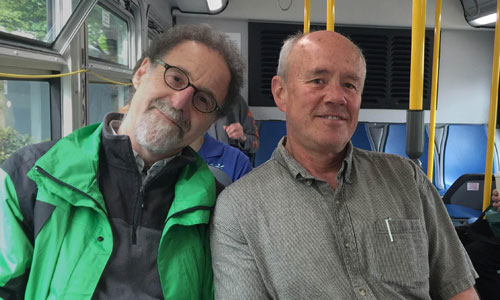
Geoffrey Hiller (left) and Tom Vandel rode TriMet Line 75 for months to cover – in photos and words – the pulse of society along its route from Milwaukie to St. Johns via 42nd Avenue. The project is on exhibit at Concordia University.

Living in Portland for two decades, photographer Geoffrey Hiller rarely rode the bus until last year.

When he lived in New York back in the 1980s, he had worked on a photo essay featuring the A-Train. But it wasn’t until returning home to Portland from a 2015 trip to Myanmar that he really noticed Bus 75.

“I wanted the energy from the trip to keep going, so I began The Hidden Portland project, which captures life along the 75 route, and it developed organically,” he said.

In May 2015, Geoffrey boarded the 75 – the bus closest to his home – getting on and off at different stops to strike up conversations at various businesses, as well as focusing his camera on the cityscape.

With a grant from the Regional Arts and Culture Council, he produced a blog and exhibit, featuring locations within a city block of the bus route, a 20-mile stretch between downtown Milwaukie and St. Johns. That includes the length of Concordia neighborhood on 42nd Avenue.

Hiller brought on board writer Tom Vandel to contribute text to the work, and the pair published an illustrated post every Monday on Bus75.org.

“While I certainly acknowledge there’s an aspect of the project that focuses on the disappearing Portland, I didn’t intend to make overt commentary on it,” Geoffrey explained. “A lot of people are trying to pick up on the gentrification aspect of the project, and we can’t deny that. We know it exists. We allude to it.

“But at the end of the day, we are trying to get at something beyond that,” he added. “I’m looking for a different angle, something that will fill in the blanks between the story of gentrification and the celebration of the old Portland.

“There are ideas and themes that a photograph can hint at, even when words fail to describe them. That’s what I seek out.”

The project blog will continue until the end of December. The Hidden Portland exhibit is on display in the George R. White Library Learning Center at Concordia University through Dec. 18. It includes several photos that never made it into the blog.

Riley, certified engineer in training, graduated from Oregon Institute of Technology with a degree in civil engineering, with an extracurricular focus and interest in community engagement through written and visual media. New to Portland, he pursues a career in stormwater management, while he continues the practice of written and visual media production. Contact him RSOBboyle13@gmail.com.

Converted fire station offers clues to early use

Posted on October 29, 2016 by Web Manager Posted in Concordia News, History

By Doug Decker, historian

The question: The building with a flagpole on the east side of 33rd near Alberta looks kind of out of place for a house, but too residential to have been a commercial building. What’s the story there? – Bianca Karjalainen, 32nd Avenue

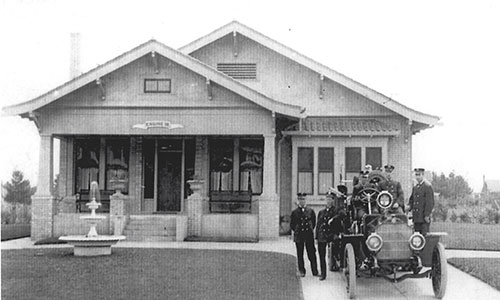
The Oregon Stamp Society building at 33rd Avenue and Alberta Court may not look like a fire station now. But it did in the early 20th century.

The historian reports: Good eye. The building in question – 4828 NE 33rd Ave. – is the current home of the Oregon Stamp Society (OSS) but was originally constructed as a fire station, home of Engine Company 34, built in 1928.

The station was opened and dedicated Nov. 1, 1928, with Captain Dan Shaw in charge and R. Mitchell as junior captain. Over the years, the station also served the neighborhood as a polling place, toy drop-off during holiday charity drives, and the focus of summer community barbecues and open houses.

During the teens and 1920s, a series of similar small fire stations – that each typically housed just one engine and were known as “three-man stations” – were constructed in the heart of Portland’s residential neighborhoods. They were designed to fit in. Have a look at similar stations at 2200 N.E. 24th Ave. and at Southeast 13th Avenue and Tenino Street which, incidentally were also decommissioned in the late 1950s.

Portland Fire Chief Lee Holden (1925- 1927), who was also an amateur architect, designed these stations. Holden’s attention to details – the choice of red brick, the wide and inviting gables and exterior columns, the operating multi-pane casement windows, the interior boxed-beam ceilings and classic interior wood trim –all speak to popular residential design elements of the period.

Much of the original station interior on 33rd Avenue has been remodeled to serve the needs of the stamp club, but there are clues to its earlier life:

  • The original fire station kitchen in the basement, with a bank of lockers to hold firefighters’ food
  • The entry and waiting area (including fireplace, mantel and built-in inglenook bench)
  • The captain’s office
  • The roof dormer, which was once the top end of a tower for drying wet fire hose

Mechanical systems, according to OSS president Eric Hummel, have been replaced several times since the society acquired the building in 1960.

The original garage door for the fire engine was on the front right of the station, but a casement window from the south side was put in its place when the opening was bricked over in the early 1960s.

The station was functional until August 1959, when fire operations for the area shifted to the new station at 19th and Killingsworth (more on that in a moment), and Engine Company 34 was sent to serve the St. Johns neighborhood.

The closure was the result of a reorganization of the Portland Fire Bureau by city commissioner Stanley W. Earl and a $3 million bond measure passed by voters in 1957 to build seven new stations across the city.

The OSS purchased the decommissioned building in 1960 for $13,500. Reportedly, a church was vying to acquire the building as well.

The neighborhood mounted a major protest in 1959 when city council chose the site across from Vernon School as the location of the new fire station. Any CNews readers remember that uproar? We’re also looking for any photos of the old station during its years of operation. Stay tuned for details in a future column.

Have a question for the neighborhood historian? We love solving mysteries. Send your question to CNewsEditor@ConcordiaPDX.org and we’ll ask Doug Decker to do some digging.

Exercise can fight the effects of gravity, aging

Posted on October 28, 2016 by Web Manager Posted in Concordia News, Health and Wellness

By Penny Hill, Rising Sun Massage

A trainer I know refers to the exercises that most of us do as ones that make the “mirror muscles” look good. You know, the tight abs, the great arms and the chiseled legs.

But today I want to talk about a set of muscles that – while no one is going to see the results of your hard work – are nonetheless critical to your well-being. They are, ahem, the pelvic floor muscles.

The pelvic floor is a set of muscles, nerves, tendon and ligaments. They attach front and back and side to side forming a hammock that supports the organs in the lower torso: the vagina, rectum, uterus and bladder.

Like all muscles of the body, they need exercise. As the pelvic organs are acted on by gravity and other pressures, they tend to move downward. This can cause changes in continence of, let’s call them, wind, water and earth. The other common causes of a weakened pelvic floor include childbirth, obesity and the associated straining of chronic constipation.

An online search will yield good exercises to strengthen these muscles. But here is an easy start. Lie down on your back and tighten the muscles at the very bottom of your torso, between your legs.

There are three separate areas to work. Start in the middle – these are the muscles that control the flow of water. Now think of tightening the area in front of that, and then the area to the rear of that. That’s it.

You may find in the beginning it is hard to locate these areas. You’ll recruit muscles from the glutes and abdomen, but keep going. Eventually you’ll be able to isolate just the ones you’re aiming for.

Remember to relax the contractions, too. You are re-establishing neural connections that have atrophied and, over time, it will become easier.

Penny, LMT, Certified EFT Practitioner can be reached through ConcordiaMassagePros.com.

Cover crops provide green manure

Posted on October 27, 2016 by Web Manager Posted in Concordia News, Gardening

By Jolie Donohue, The Gardening Goddess

Cover crops, sometimes known as “green manure,” are quick growing and planted primarily to keep the soil covered for a short period, often during fall and winter. Then plowed under, they reduce erosion and suppress weeds by providing competition.

When the lush green decomposes, it returns large amounts of nutrients and organic matter to the soil. That stabilizes moisture content and improves garden soil texture.

Members of the legume family – crimson clover, Dutch white clover, fava beans, Austrian peas and vetch – return nitrogen to the soil. They host nitrogenfixing bacteria and extract nitrogen from the air and convert it into a form that can be used by plants.

Other cover crops include rye, buckwheat and oilseed radish. There are also seed mixes that contain various cover crops.

Fall is a great time to plant cover crops. Unless you are growing winter crops, you are probably cleaning up and putting your vegetable garden to bed at this time of year. So why not plant some cover crops?

Depending on the variety you choose, they are usually seeded before November. Plant cover crop seeds by broadcasting, check seeding rates for individual varieties. The seeds must be covered by soil and kept evenly moist while germinating. Most cover crops need full sun.

Every year at the beginning of October, we plant crimson clover in three raised beds. With a daily light watering, we are rewarded with germination in less than seven days, then lush green grass followed by bright flowers in the spring that attract bees before being turned over.

Fava beans are another excellent cover crop that grows into tall three-foot vigorous plants with beautiful flowers. The deep taproot loosens up those hard clay soils we have here.

Oilseed radish have the same beneficial taproot quality of fava beans; however, they are in the cabbage family so you need to consider them in your garden crop rotation schedule.

Rye germinates quickly and tolerates harsh conditions. Their dense mat of roots makes them excellent erosion controllers.

Jolie is a Concordia neighborhood resident who offers garden design and consultation services, and teaches workshops about therapeutic horticulture, floral design and seasonal recipes. For more information, visit MissJolieAnnKitchenGarden.blogspot.com and JolieAnnDonohue.com.

Concerned about driving, citizen safety

Posted on October 24, 2016 by Web Manager Posted in Concordia News

Letter to the editor

Every morning I walk my dog in our neighborhood, and every morning I see many people speeding, running stop signs, and ignoring crosswalks. Two people in less than 10 days have come up to the light at 33rd and Ainsworth and pulled into the crosswalk WHILE I’M IN IT. This morning I had to slap the hood of the car to get the driver’s attention as he was rolling forward into me.

People aren’t paying attention to our traffic laws. They’re using their phones, eating, or generally distracted.

I live across the street from the Faubion Grade School construction site, where they are going to increase the number of students by a few hundred kids when it reopens. Dekum Street has become a speedway because it’s long with no stops. What will happen when we have all those kids starting school?

I called the police. They called me back a week later and said I could rent a “slow down” sign, and they would try to increase patrols. I haven’t seen more patrols.

We have many more people moving here. The police are severely understaffed, our infrastructure is bursting at the seams, many roads are in disrepair, and with all these new people come more cars. We need to start working together. I expect my city to be proactive, not reactive.

As for drivers, including myself, we need to remember each corner is a legal crosswalk for pedestrians, even if there are no stripes painted on the road.

James Keyes

We should not get rid of cars so quickly

Posted on October 23, 2016 by Gordon Riggs Posted in Concordia News, Opinion

Is the city of Portland, abetted by developer-friendly activists, trying to abolish private automobiles? It certainly looks that way when you consider a report by mayor Charlie Hales’ planning department, a group styling itself Portland for Everyone and several informal groups.

A picture in a June pamphlet published by the Bureau of Planning and Sustainability for the Residential Infill Project features a row of four “skinny” houses with driveways, two with cars. A second version of the picture shows the same houses with the cars and driveways photoshopped out.

The city doesn’t just make off-street parking vanish. The report allows no “front-loaded” garages at all.

Portland for Everyone is pretty much in accord with the city’s call for smaller houses, lower roofs and mostly shorter setbacks. It would go further to outlaw off-street parking. Its website urges us to “end stealth parking subsidies,” that off-street parking runs up the cost of housing and “tilts the scale toward automobile usage and away from forms of transportation that work better in cities.” Works better for whom?

Some of us have arthritis, or groceries or young children to carry. We don’t want to drive around the block to find a place to park.

Clearly the trend is away from cars. Presently in Portland there is less than one car per household. Perhaps in the future all will walk, ride a bicycle or use public transportation.

There are alternatives that address many of the points of the anti-car people. I have gotten permits for and presently am building a residence that addresses many issues raised:

  • Do away with garages. Most people use their garages for storage rather than car shelter. I got an “exception” to my permit for a parking space in front of the house. Answering the charge that garage doors are ugly, my house will have a front window and no garage.
  • Make driveways permeable, not concrete slabs. I am using an open concrete lattice.
  • Group driveways for adjacent houses. A driveway has only to be nine feet wide. Adjacent houses could share a driveway that branches off to each neighboring house.
  • Alleys that abut 15 percent of Portland lots. Cleaning and using them for car access would make neighborhoods more livable.

Bicyclists, walkers and bus riders have rights. They may be the wave of the future. But it shouldn’t be all at once.

We shouldn’t just slam the car door on private transportation.

Opinions expressed by these writers do not necessarily reflect the views of Concordia Neighborhood Association. Deadline is the 10th of the month prior to publication. Please contact CNewsEditor@ConcordiaPDX.org earlier to discuss space limitations.

Land use, transportation & livability update

Posted on October 22, 2016 by Web Manager Posted in Concordia News, Land Use & Transportation

By Ben Earle Secretary, CNA LUTC

The LUTC plate brims with substantial developments on three issues that will affect Concordia neighborhood livability for years to come.

Portland 2035 Comprehensive Plan
The Concordia Neighborhood Association (CNA) Board approved a LUTC-drafted letter to city council that supports a modified version of the Residential Infill Project’s (RIP) “Housing Diversity Perspective.” The RIP’s purpose is to identify how best to reduce house size and retain neighborhood character and livability, while increasing the range of housing types to address community concerns about the scale of new homes and current housing supply challenges.

The topics of the city council’s Oct. 6 and 13 public hearings on the Portland 2035 Comprehensive Plan are the updated zoning code and map changes that reflect the early implementation components of the plan adopted June 15. These updates include the R5 to R2.5 rezoning for homes in the Killingsworth-to-Jarret corridor from 22nd to 33rd as well as the CM-1 and CM-2 mixed-use zoning determinations that both the CNA and Concordia residents provided input about on multiple occasions.

For more information and to submit comments online or via letter, visit PortlandOregon.gov/bps, email PSC@PortlandOregon.gov, or call 503.823.7700.

Traffic safety
See CNA chair Garlynn Woodsong’s report about the city’s reluctance to reduce speed limits on Alberta and Killingsworth streets.

Jessica Horning, Oregon Department of Transportation (ODOT) bicycle/ pedestrian coordinator, attended the Sept. 21 LUTC meeting. She presented the “Safety and Active Transportation Enhancements” project for the US 30B/ Lombard Street corridor, from the St. Johns Bridge to Northeast 162nd Avenue. These improvements include lane reshaping and restriping, signage and signal upgrades, new lighting, sidewalk upgrades and Americans with Disabilities Act ramps, and renovated pedestrian and bike lane paths.

In response to CNA’s advocacy for changes to the 42nd Avenue overpass bridge access to better ensure safe passage for bicyclists and pedestrians, ODOT will construct a new eastbound path behind the guardrail. As well as providing a much needed sidewalk, this will provide protected access to the 42nd ramp where the bridge supports currently create a “pinchpoint” in the bike lane that forces bicyclists into traffic.

Project construction is slated for the first week of November with completion in early 2017. As ODOT continues to assess viable solutions for the more complicated westbound access situation, it will also consider the LUTC’s suggestions for possible additional short-term additions such as road diets, warning signs with flashing lights, etc.

Bighouse development
As of press time, there is no new news to report on any design changes for the four-story apartment building underway at Northeast 30th Avenue & Killingsworth Street. Stay tuned for the next update in the November CNews.

Concordia residents are always welcome at CNA LUTC meetings, 7 p.m. every third Wednesday in the McMenamins Kennedy School Community Room. For more information, visit the Concordia Neighborhood Association website, send your questions to LandUse@ConcordiaPDX.org or email LUTC_Secretary@ConcordiaPDX.org to join the LUTC notification list.

Update on speed limit reduction requests

Posted on October 21, 2016 by Web Manager Posted in Concordia News, Land Use & Transportation

In January, Concordia Neighborhood Association (CNA) made a formal request to the city of Portland to lower the speed limits on Alberta and Killingsworth streets.

Last December, CNA’s Land Use & Transportation Committee (LUTC) recommended – and in January, the CNA Board unanimously adopted – a proposal to request the city lower the speed limits on Alberta from 25 to 20 mph, and on Killingsworth from 30 to 25.

The 20 mph on Alberta would match the limit on Fremont Street through Beaumont Village, in keeping with state statutes for commercial districts.

The 25 mph on Killingsworth would more closely reflect its status as a mixeduse pedestrian and bicycle corridor through a residential area.

Oregon statutory standards for speeds are:

  • 15 mph – alleys, narrow residential roadways
  • 20 mph – business districts, school zones
  • 25 mph – residential districts, public parks, ocean shores

Here’s the current status of our requests:

Alberta Street – The request has not yet been investigated. It was finally assigned to a traffic engineer at the end of August.

Killingsworth Street – In early August, the city wrote, “After reviewing available data, we have determined the current speed zones on Killingsworth to be appropriate, given the layout, and similar to other comparable-sized roads in the area. Therefore, no changes were recommended.”

It seems pretty clear the city engineer studying Killingsworth reached the wrong conclusion. The question should be, for the business districts on Killingsworth, what justification does Portland have for not implementing the 20-mph statutory business district speed? For the balance of Killingsworth, which runs through a mix of residentially-zoned properties, what justification does Portland have for not implementing the 25- mph statutory residential area speed? What is the rationale and justification for higher speeds in these locations, despite injuries and fatalities?

A local lawyer has taken notice, and wrote, “The Vision Zero Crash Map shows two people were killed while walking, and 33 people were seriously injured while walking, bicycling or using vehicles in 2005-2014 on N/NE Killingsworth. Those numbers appear similar to other comparable-sized streets in the area where speeds are similar… and where there are many businesses, schools, residences, and users of all modes. I believe it is reasonable to expect that if speeds and right-of-way uses stay the same, Portlanders will continue to die and suffer serious injuries on N/NE Killingsworth and on our other comparable sized streets.”

It’s my understanding the Oregon Department of Transportation (ODOT) has granted 95 percent (36 of 38, as of 2015) of Portland’s requests to lower speeds that were higher than the statutory speeds. I hope the city will increasingly feel it has engineering, moral and political mandates to seek revocation of ODOT orders on streets like Killingsworth, where speeds are posted at higher than statutory speeds, and where Portlanders are dying and suffering serious injuries.

CNA is appealing the city’s Killingsworth decision, and the issue is currently being re-examined by the city’s traffic investigations manager.

The city is also asking ODOT to consider all modes with a new proposed methodology for adjusting speeds on local streets (as reported recently by the Portland Tribune). Unfortunately, Killingsworth will not qualify, as it is classified as an arterial. Only collector and local streets would be eligible under the proposed guidelines. However, the traditional speed zone adjustment request would still certainly be feasible for Killingsworth.

« Previous Page
Next Page »

To connect Concordia residents and businesses – inform, educate and report on activities, issues and opportunities of the neighborhood.

Concordia Neighborhood Association will abstain from publishing anything that could be construed as libel.

Upcoming Events


CNA Meetings

Click here to learn about upcoming CNA meetings and how to attend.

CNA’s Facebook Group

Join us for neighborhood discussion, event updates, meeting minutes and more on our Facebook Group.

Categories

  • Archive
  • Arts & Culture
  • CNA
  • Concordia News
  • CU Sale
  • Events
  • Family
  • Gardening
  • Health and Wellness
  • History
  • Land Use & Transportation
  • Local Businesses
  • News from the NET
  • Opinion
  • Schools
  • Trees
  • Uncategorized
  • Volunteer Opportunities
CyberChimps ©2026